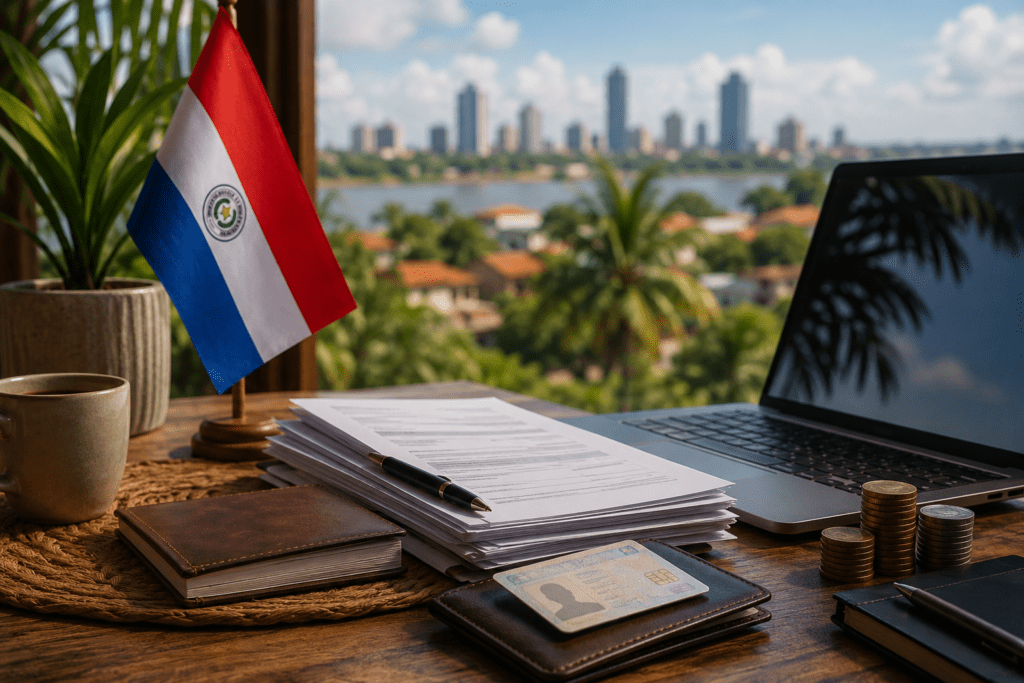
There are many reasons why it makes sense to obtain a residency and Cédula in Paraguay. In recent years, Paraguay has become increasingly important as a tax residence.
Especially for people with digital or worldwide income, tax residence in Paraguay is a very good idea. Not everyone is happy with a tax burden of 70% in high-tax countries. In these cases, Paraguay offers a very good alternative, where in certain areas it is possible to legally benefit from a 0% tax burden.
1. The Cédula is the beginning
For most people, applying for a residence permit and Cédula is the first step after moving to Paraguay. Some want to live here directly and benefit from the low cost of living.
Others want to invest in Paraguay and, for example, invest in real estate in Asuncion and find a stable cash flow through AirBnB as well as significant increases in value.
Still others see Paraguay as a “Plan B” or are simply looking for a legal way to optimize their tax burden.
In all of these cases, the first step is the residence permit and Cédula. However, anyone looking for legal certainty regarding their tax situation still has up to 4 additional options for improvement.
2. The RUC forms the basis for tax administration
A central role is played by the RUC; Paraguay's tax identification number.
Legally, a person has their tax residence in Paraguay as soon as they either have permanent residence or a RUC. From this point, a tax residence certificate can be applied for.
This “certificado de residencia fiscal” is a very important document, especially in the event of a tax audit.
At the same time, ongoing obligations arise. These include, among other things, the monthly IVA return (value-added tax), which is filed every month. For a small fee, a local tax advisor can take care of this for you.
We have local tax advisors on our team who can handle this easily for our clients.
3. The country of origin may assess the tax situation differently
Tax recognition by Paraguay and the assessment by the person’s previous country of residence are sometimes two different things.
Even if a person is tax resident in Paraguay, they may continue to be considered tax resident in their country of origin under that country’s rules. This can be the case, for example, if they spend more than 183 days per year there, or if they continue to have stronger family, economic, or personal ties to their country of origin.
For small businesses that are just starting out, this is practically never a problem. However, as the amounts become larger, it becomes increasingly useful to strengthen the case for Paraguay.
At this stage 3, this is done by also starting to issue invoices and thereby actually beginning to pay taxes in Paraguay. In Paraguay, you can offset your entire cost of living against your income. There is also no strict separation between business and private expenses as in Europe.
The top tax rate is 10% and is only charged on the net profit that remains after all costs have been deducted.
3B. Where the work is performed plays an important role
For people who work internationally, it is not only important where the customer or company is located. It is also crucial where the activity is actually performed.
Income from work that a person physically performs in Paraguay while living there is considered local income under the regulations mentioned in the original text. Reference is made here to Law 6380 of 2019.
This can also apply if the invoices are issued through a company based outside Paraguay.
If, on the other hand, the work is actually performed outside Paraguay and purely digitally, invoices can also be issued that are not subject to VAT. Our clients are welcome to clarify such borderline cases directly with our team or the local tax advisor.
4. Invoices document economic activity
Anyone who lives in Paraguay at least part of the time can, as described above, further reduce their taxes in Paraguay through expense invoices. This has the additional advantage that it demonstrates economic activity in Paraguay.
The accounting records therefore contain not only evidence of income, but also of expenses in Paraguay. As a result, more economic transactions are also recorded in the monthly IVA form. This documents concrete economic activity in Paraguay.
In the event of a tax audit in the country of origin, this creates an even stronger argument for actual tax residence in Paraguay.
5. IRP – personal income tax
As income levels increase, the IRP – Impuesto a la Renta Personal – comes into play.
The IRP becomes mandatory when annual revenue exceeds 80 million Guaraníes. This is approximately 11,000 euros or 13,000 US dollars. The legal basis is Law 6380 of 2019.
Only with the filing of the IRP does an annual tax return arise.
Banks and financial authorities may request evidence of a person’s tax situation as part of an audit.
While VAT in Paraguay is paid or declared monthly, an annual income tax return is a much more familiar format internationally.
By filing the annual IRP return, we have the strongest argument for actual tax residence in Paraguay in our hands!
The US LLC and tax residence in Paraguay
For years, one model has proven particularly effective for digital nomads and many people with worldwide income. It is a single-member LLC in the USA, operated with a Paraguayan Cédula and residence in Paraguay.
With this solution, the profit is not taxed in the USA – as long as business is conducted outside the USA – but in the country of tax residence. If this is, for example, Germany because the person uses their German passport or address in Germany, then the full German tax rates apply.
If, however, the tax residence is in Paraguay, the local tax rates apply, which for this type of business are often 0%.
This very practical solution can already be used directly after receiving the Cédula. We recommend that our clients, in any case, also obtain a RUC in Paraguay for solutions of this kind.