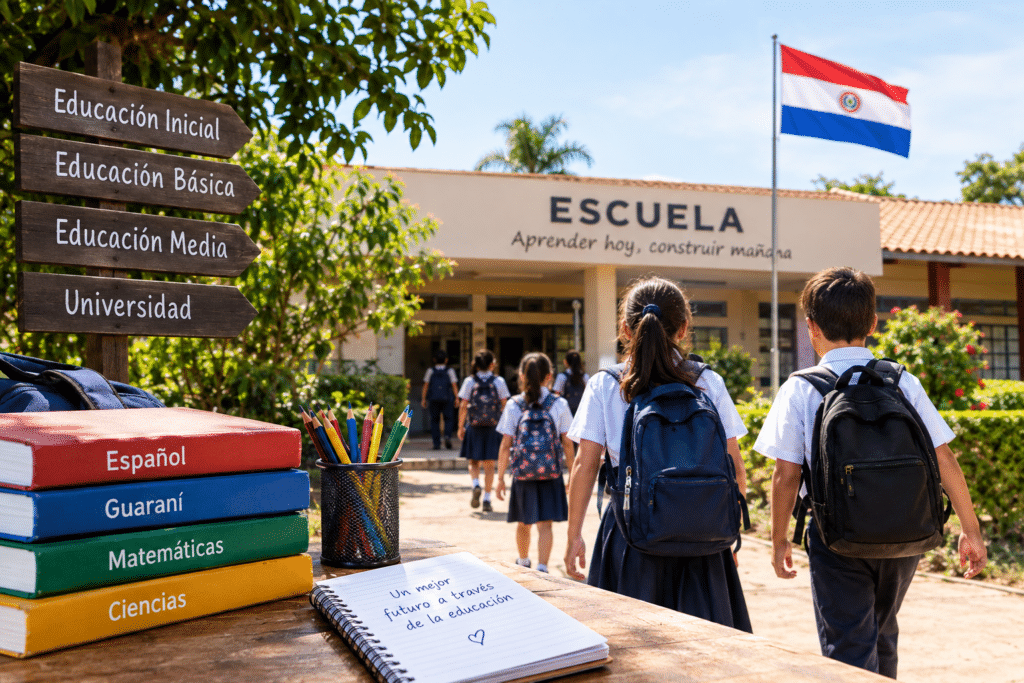
Anyone moving to Paraguay with their family or planning an extended stay should also take some time to familiarise themselves with the local school system. What school levels are available? How long does compulsory education last? What are the differences between public and private schools? And what options are available for children?
In Paraguay, the school system is divided into several educational stages. The Educación Escolar Básica comprises nine school years, followed by the three-year Educación Media. Upon completing upper secondary education and obtaining the Bachillerato qualification, students can pursue further studies or vocational training.
THE STRUCTURE OF THE PARAGUAYAN EDUCATION SYSTEM
The formal school system in Paraguay is generally divided into three stages: Educación Inicial, Educación Escolar Básica and Educación Media. These are followed by higher education.
| Educational level | Typical age group | Duration |
|---|---|---|
| Educación Inicial – Early Childhood Education | 0–5 years | Optional from 0 to 4 years; compulsory from age 5 (Preescolar) |
| Educación Escolar Básica – Basic Education | 6–14 years | 9 years (compulsory education) |
| Educación Media – Secondary and Upper Secondary Education | 15–17 years | 3 years |
| Educación Superior – Higher Education | Depending on the course of study | Varies |
SCHOOL YEAR AND HOLIDAYS
The school year follows a different schedule from that in Germany. It usually begins in February and ends towards the end of November. For 2026, the Ministry of Education set the start of classes for 23 February and the end of the regular school year for 30 November. The winter holidays take place during the Paraguayan winter, usually in July.
GRADING SYSTEM AND SCHOOL HOURS IN PARAGUAY
There are also some differences between Paraguay and Germany or Austria when it comes to grades and school hours.
The Paraguayan grading system uses a scale from 1 to 5, with 5 being the highest grade and 1 the lowest. The minimum passing grade is usually 2. This means that the grading scale is effectively the reverse of the system used in Germany and Austria: in terms of ranking, a Paraguayan grade of 5 is broadly comparable to a German or Austrian grade of 1, which represents excellent performance.
School hours also vary from one school to another. Many schools operate separate morning and afternoon shifts. Regular classes often last around four to five hours per day. For example, morning classes may run from 7:00 a.m. to 11:30 a.m., while afternoon classes may take place from approximately 1:30 p.m. to 5:30 p.m. Hours may differ in the upper grades.
Some private schools and international educational institutions offer an extended school day, with classes continuing into the afternoon and sometimes including additional language, sports or childcare activities. Depending on the school and the availability of places, parents can often choose between different school schedules. It is advisable to contact the school directly to find out whether morning or afternoon classes are available and how long the school day lasts.
EDUCACIÓN INICIAL: KINDERGARTEN AND PRESCHOOL
Early childhood education begins before children formally enter school. It is entirely optional from birth to age four and only becomes part of compulsory education at the Preescolar stage, for children aged five. It comprises several stages adapted to the children’s ages and development.
- Maternal: Early childhood care and education for the youngest children, usually from birth to age two.
- Prejardín: An early educational stage generally attended from around age three.
- Jardín: Kindergarten, usually for children aged four.
- Preescolar: Preschool for children aged five.
For families newly arrived in Paraguay, attending preschool, such as Jardín or Preescolar, can be a good way for children to become familiar with their new linguistic environment.
EDUCACIÓN ESCOLAR BÁSICA AND EDUCACIÓN MEDIA
At around six years of age, children begin Educación Escolar Básica, which comprises nine school years. It is compulsory and forms the foundation of the Paraguayan school system.
The nine school years are divided into three cycles:
- First cycle: Grades 1 to 3
- Second cycle: Grades 4 to 6
- Third cycle: Grades 7 to 9
The curriculum covers fundamental knowledge and skills. Subjects include languages, mathematics, natural and social sciences, as well as other subjects depending on the respective curriculum.
After completing the nine years of Educación Escolar Básica, students can attend the three-year Educación Media. Different educational pathways are available.
The Bachillerato Científico is academically oriented and may offer specialisations in areas such as mathematics, natural sciences or social sciences. The Bachillerato Técnico combines general education with vocational specialisation, for example in information technology, administration, industry or agriculture. The specific programmes available depend on the school.
WHAT TYPES OF SCHOOLS ARE AVAILABLE IN PARAGUAY?
Public schools are the obvious choice for many families. Educación Escolar Básica is generally free of charge in public schools. Teaching follows the national curriculum and is conducted primarily in Spanish. Guaraní is also taught as a school subject, as both languages play an important role as Paraguay’s official languages. The legal framework provides for the child’s mother tongue to be taken into account and for the other official language to be taught from the beginning of their education.
English is also part of the statutory educational requirements, with at least two hours of instruction per week from preschool through the end of Educación Media.
In addition to public schools, Paraguay has numerous private and international educational institutions.
Private schools generally charge tuition fees. In return, depending on the institution, they may offer additional programmes, different school schedules or a particular language focus. The services and facilities available vary from school to school.
GERMAN AND INTERNATIONAL SCHOOLS IN ASUNCIÓN
Goethe-Schule Asunción
The Goethe-Schule is a German school abroad that combines German educational standards with the Paraguayan curriculum. In addition to the national Bachillerato, students can obtain the German Language Diploma (Deutsches Sprachdiplom). The Bilingual International Baccalaureate (Gemischtsprachiges Internationales Baccalaureat, GIB) is particularly interesting for families who want to keep open the possibility of studying in Germany or other countries later on.
Further information: Colegio Goethe
American School of Asunción (ASA)
The American School of Asunción charges relatively high tuition fees but offers an American-oriented curriculum from kindergarten through Grade 12. Instruction is primarily in English. At the same time, Paraguayan curriculum content is covered, including Spanish, Paraguayan studies and Guaraní. Graduates of the relevant integrated programme can obtain both a US high school diploma and the Paraguayan school-leaving qualification. The school is accredited by Cognia and Paraguay’s Ministry of Education (MEC).
Further information: American School of Asunción
Colegio Internacional and Colegio Iberoamericano
Other private schools also offer enhanced foreign-language instruction. Colegio Internacional, for example, places considerable emphasis on English and prepares students for international language examinations. Colegio Iberoamericano offers German lessons as well as various Bachillerato pathways, including scientific, humanities and technical specialisations.
Further information: Colegio Internacional and Colegio Iberoamericano.
GERMAN-LANGUAGE SCHOOLS AND SPECIAL EDUCATIONAL OPTIONS IN THE INTERIOR
There are also interesting alternatives outside the capital.
Centro Educativo Independencia, known as Deutsche Schule Independencia, is located in Colonia Independencia in the Department of Guairá. This private school offers education from kindergarten through upper secondary level and combines Spanish, German, Guaraní and English. It also prepares students for the German Language Diplomas. For families who want to live in Paraguay’s interior while maintaining a strong focus on the German language, this school can be an interesting option.
Further information: Centro Educativo Independencia – PASCH.
There are also schools in Villarrica, such as Colegio Internacional and Colegio Técnico Experimental Universitario de Aplicación (CUTEA), among others, which may offer interesting educational options.
CONCLUSION
The Paraguayan school system offers a range of educational pathways, from public schools and private institutions to multilingual and international programmes. Educación Escolar Básica comprises nine years, followed by three years of Educación Media, which can be completed with the Bachillerato qualification.
For most families planning to live permanently in Paraguay, language integration and the distance to school are often key considerations. However, families who want to keep the option of moving to Germany or elsewhere open in the future will also find several interesting alternatives in Paraguay.
OFFICIAL INFORMATION AND FURTHER SOURCES
OeAD – Austria’s Agency for Education and Internationalisation: https://oead.at/en/
Ministerio de Educación y Ciencias (MEC) – Paraguayan Ministry of Education: https://www.mec.gov.py/
Ley N.º 1264/1998 – General de Educación: Paraguayan legal framework for education. Available through the official legal information sources of Paraguay.
DAAD – German Academic Exchange Service: https://www.daad.de/en/
Anabin – Information on the assessment of foreign educational qualifications in Germany: https://anabin.kmk.org/